


You want to conveniently haul your wheels to the track? Will an over engineered coffee table suffice?
A fellow W201 enthusiast had a problem that needed solving. Securely transport track wheels with style and pizzazz (I added that last part). This idea dwelled in my mind for a long time before actually getting to work. Proper carbon fiber manufacturing is a very expensive process, so how can someone justify spending money on something that is not “needed”? Well, people wear Rolexes while having a phone in their pocket, drive exotic cars to get groceries, and have something called “fashion” when they could more conveniently and cheaply wear potato sacks, so this was obviously a moronic question. Of course I’m going to make your fancy seat delete, but I just need to figure out how to do it in a way that matters to me. Most of the idea generation and design work took place while staring off into the clouds, trees, birds and the dark liquid of triple shot espressos.
In composite manufacturing, anything that is designed with a curved surface requires a dedicated mould, more in depth surface preparation, post finishing, and higher shipping costs. To dedicate all that effort to a product with such a specific purpose seemed unjustifiable. Then the gears started turning. Rather than using benchmarks as a starting point, I began with freshly tilled soil ready for sowing. The seeds being planted in pure functionality, and whatever aesthetics happen to bud, would be nurtured.
The most functional way to store and move something is usually on a flat surface. This was a great basis, because in product design, if the object is only limited to 2 dimensions, then it can travel anywhere on a flat surfaced mould. As soon as features are incorporated along a 3rd dimension is when that object becomes locked into place, requiring a dedicated mould. With extensive experience designing with this mindset, this seemed like a promising branch to continue on. You will find many products on the website that are flat in profile, and with these products youll also notice that they are the most customizable. This is extremely beneficial as it is much easier to improve designs, try new things, and meet customer requests. Flat it is. As the old saying goes, “keep it simple Salvator Mundi.”
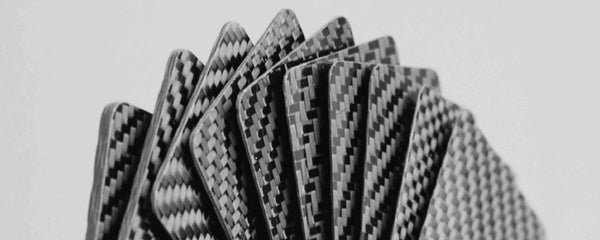
Now, something that may be misunderstood with carbon fiber, is how it actually behaves in different shapes. Often touted as the strongest material ever (and sometimes misidentified as bulletproof, that would be aramid), it would be a mistake to start engineering with that premise. Carbon fiber (when infused or impregnated with a strong epoxy resin binder) is very light and stiff compared to many other materials that came before it, but if someone handed you, let’s say a 2mm thick, meter-long strip of carbon, you would probably be confused as to why it is so wobbly. On the same train of thought, when you watch ultra slo-mo video of an F1 car taking a curb, you’ll probably be shocked at all the flexing and jittering of all the body work. Fortunately, there is a solution to this problem; it comes in the form of a delicious ice cream sandwich. When two thinner layers of carbon fiber (or cookie) are bonded on either side of a lightweight core structure (foam, honeycomb, ice cream etc) the resulting panel is many times stiffer and lighter compared to a thicker solid sheet of carbon fiber. OK, problem solved, and we will be using foam core, and unfortunately not ice cream.
“Ahh, good.” Matt thought as he was grinding his 18 grams (reduced from 21 grams) of coffee into just the right granular size to pull a 30 second shot at about 9 bar of pressure to get approximately 1.5x the amount of brewed liquid in his tiny cup. “This project seems doable now, I shall get to work on some sketches and this shouldn’t take longer than a week before I can start making it.” Little did Matt know, that one week would turn into one month, then many months.
After nearly 2 years, it finally was done. A meticulously engineered, expertly crafted, motorsports inspired…coffee table. Now, if there are any signs of needing to quit caffeine then this might just be one. So, what exactly happened here? Without getting too deep into how my mind operates, I’ll just say, if you’re going to do something, you might as well over do it. I eventually realized that my entire life has operated on a very important principle, which I believe applies to everything in life, and that is: Limitation is the catalyst for innovation. And I know anyone with an old car will agree, that when you are trying to fix something that is 20+ years old, conventional methods don’t cut, and you need to be resourceful. I also became aware through the connectivity of social media, that many W201 owners and classic car enthusiasts have aligning lifestyles. Interests in photography, architecture, home décor and music are common ground. This gave me enough justification to share another one of my interests, as I felt like it would be appreciated in the right way.
I live in a climate where the white stuff comes down hard, and prevents any possibility of enjoying the old toy car. That means that unless work is being done to it over the winter, every single modification and usefulness is limited to about half of the year. With this product being even further limited to full potential to track days (apart from a little visual flare with your bench seat removed). The functionality for this product to convert to a lounge table means that it has 100% usefulness any day of the year. And also, constructing an awesome looking flat piece of extremely expensive and stiff material, and not using it as a table, could be very obviously seen as something being “left on the table”, so to speak.
“Obtuse trapezoidal” is a fun sound to spout from your mouth. This shape probably looks familiar, it’s seen in a lot of modern designs, architecture, mid-century modern furniture, probably most predominantly in Scandinavian furniture design. For me, it is the first shape that comes to mind when I think of the 190E. The C-pillar being one of the first spots the eye is drawn to, partly because of the triple slit vent (functional by the way), but more so by the angles of that ‘obtuse trapezoid’. Furthermore, the design team under Bruno Sacco took this simple shape and added more dimensionality to it by blending to the roof panel and the rear windscreen and boot-lid. So rather than having a ‘box’ design where things only look appealing orthographically, the W201 looks stunning no matter what angle you are looking at it from. So, that being said choosing this shape for the detachable legs was obvious, not only aesthetically, but functionally as well, where having the bulk of material available up high for interfacing to the main panel, and tapered down towards the floor as to free up more room for foot space is ideal for a table.
What was left now were the fidgety bits, which are always fun to develop, as these small details can often take the longest to get right. Incorporating the motorsports functionality and vibe, all these attachment parts needed to be easily operated, replaceable, robust and intuitive, and also have a little sprinkle of innovation and flair. The legs are attached using a simple slot feature, and are held into place using Protex stainless steel adjustable latches interfacing with a hook feature that is machined into the leg. One predicament with using latches was when in wheel haul mode, the latches would be dangling and potentially rattle. The W201 being a car that has very little creaks and rattles even with being 40 years old, I certainly didn’t want to introduce something to tarnish this reputation. Here comes the innovating part. What started off as an elastic band, turned into a flat piece of rubber, and finally evolved into a specifically engineered shape, 3D printed with a flexible material. This little part might be my favorite of the entire project, as the idea grew quickly and the results were better than I envisioned.
This is just a small peak into the development of the ‘seat delete’. I will leave the rest for you to discover and to experience, and hopefully enjoy for a long time. Products like this are the most fulfilling for me to design and while they take the longest to develop, they end up being bearing the most fruit that hold a special life force. I hope all of this transfers to you, and that although we are separated by borders and oceans, we can communally enjoy these rituals of creating, of being and of admiring all things that embody quality.
Cheers,
Matt